









01 / 13

THE FLOOR MUST LOOK GOOD ... FOR YEARS TO COME

The floor is one of the most important elements of a building, both in terms of image and operating costs.
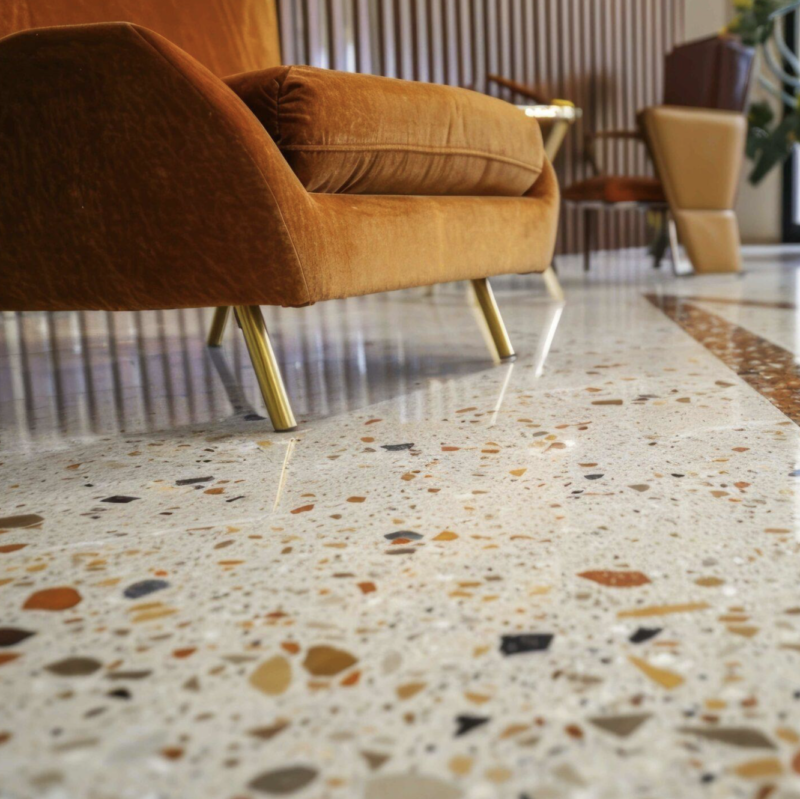
  • affects the perception of the entire facility
  • works daily under the traffic of people and equipment
  • generates lifetime costs

MOST INTRACTABLE PROBLEMS

What hurts terrazzo users the most?

  • stains difficult to remove
  • salt destroys the structure
  • cracks and nicks
  • decrease in abrasion resistance
  • damage from impacts
  • chipped and dirty expansion joints
  • heavy soil removal
  • high maintenance costs
  • high renovation costs
  • Disruptive shutdowns during renovations

👉 This is not a matter of aesthetics these are real costs and operational problems

COMPARISON OF SYSTEMS

Let's compare two approaches to terrazzo

Terrazzo Classic

cement system

Terrazzo Exclusive

epoxy system

👉 At the start they look similar. The differences come out in time.

OVERVIEW

Stain resistance starts with the structure of the material

Terrazzo Classic (cement matrix)

  • high absorbability
  • lack of stain resistance
  • Salt (winter period) degrades the surface
  • material absolutely requires additional protection
  • resin coating
  • or chemical hardening and impregnation (lower resistance, more natural appearance)

Conclusion: Resistance depends on the protection used; without it, rapid degradation and staining, and with it, additional costs, maintenance and the risk of losing aesthetics over time.

Exclusive (epoxy matrix)

  • zero absorbability
  • Chemical resistance throughout the material
  • No need for safeguards
  • No absorption of stains and chemicals
  • easy to keep clean

Conclusion: Consistent resistance throughout the terrazzo, no risk of stains and an unchanging appearance over time, while simple maintenance and low operating costs.

BREAKING

The most common construction problem

Terrazzo Classic (cement matrix)

  • Flexural strength 5-10 MPa, modified terrazzo max 20 MPa (after 30 days)
  • Tensile strength of about 5 MPa, modified to max 10 MPa (after 30 days)
  • required transfer of expansion joints from the subfloor and use of flexible expansion joints (e.g., double angle with flexible filling), with a width of min. 7 mm

Conclusion: Very high probability of transferring the scratch from the primer to the terrazzo surface, troublesome, eventually visible crack repair.

Exclusive

  • Flexural strength 31 MPa (after 24h)
  • Tensile strength 33.1 MPa (after 24h)
  • world's most flexible terrazzo system
  • the possibility of using a flexible membrane to protect against cracks and compensate for the deformation of the substrate

Conclusion: Definitely less likelihood of transferring a scratch from the primer to the terrazzo surface - quick repair, virtually invisible. With the use of a membrane, no cracks.

WASHINGTON

real resilience over time, not just at the beginning

Terrazzo Classic (cement matrix)

  • good to start → later dependent on maintenance and intensity of use
  • resistance depending on the protection layer
  • After its wear (maintenance errors) → soaking and lack of chemical resistance
  • Lack of resistance to salt, aggressive cleaning agents → matrix damage
  • Damage to the matrix → crumbling, discoloration and surface degradation
  • drastic reduction in abrasion resistance

Conclusion: Abrasion resistance decreases as the surface layer wears down, leading to a deterioration of the floor's appearance. With use, maintenance costs increase and become difficult to predict.

Exclusive (epoxy matrix)

  • high resistance throughout the life of the floor
  • does not require an additional protective layer to prevent degradation
  • zero absorption and chemical degradation potential
  • flexible matrix cushions micro stresses
  • No micro-damage and stable structure

Conclusion: consistent resistance independent of any coating, unchanged appearance over time, and predictably low maintenance costs.

HITS

Bumps and falls of objects occur during use

Terrazzo Classic (cement matrix)

  • impact resistant
  • hard and rigid structure
  • after exceeding the strength, the damage is chipping sometimes cracking
  • resulting surface damage, requires repair

Conclusion: When the strength is exceeded, visible damage (chipping, cracking) develops, which deteriorates the appearance of the floor and requires repairs.

Exclusive (epoxy matrix)

  • impact resistant
  • flexible matrix cushions energy
  • When strength is exceeded, a local indentation is formed instead of damage
  • mostly invisible to the user

Conclusion: When the strength is exceeded in most cases, a local, usually invisible indentation is formed instead of surface damage.

DILATATIONS

Expansion joints should combine technical requirements with architectural expectations.

Terrazzo Classic (cement matrix)

  • the need to relocate all expansion joints
  • contraction expansion joints, usually in the form of double profiles filled with elastic mass
  • width usually from about 7 mm to >10 mm
  • Often the mass has a concave meniscus, materials prone to staining
  • Possible system expansion joints, wide, visible, less aesthetic (difficult to handle during grinding)

Conclusion: Expansion joints should be moved from the subfloor, usually in the form of double profiles with flexible filling.

Exclusive (epoxy matrix)

  • The need to relocate expansion joints from the subfloor
  • contraction expansion joints - a single profile is sufficient
  • width from about 1 mm
  • possibility to use metals (brass, aluminum, stainless steel)
  • No need for elastic masses
  • The possibility of using an epoxy membrane and eliminating expansion joints

Conclusion: Sleek and aesthetically pleasing expansion joints that can be used as an architectural detail and that are easy to maintain.

⚠️ Structural expansion joints - always required require system profiles or customized solutions

KEEP

costs that are not visible at the beginning

Terrazzo Classic (cement matrix)

  • resin coating and protective layers required
  • higher chemical consumption
  • longer cleaning time
  • The need for periodic renewal of security features
  • coatings difficult to maintain, with a high risk of wear, degradation and sometimes permanent damage to the floor
  • In practice, it often ends up being renovated or refurbished

Conclusion: Higher costs and more demanding maintenance; in practice, difficult to implement at an adequate level, even with the guidelines provided.

Exclusive (epoxy matrix)

  • simple, standard washing
  • less chemical consumption
  • No absorption of terrazzo throughout and high chemical resistance
  • easy maintenance by cleaning staff
  • possibility to use simple support coatings (fast application, short drying time)
  • No need for cyclical repairs
  • Refresh the surface, every 3-4 years possible in one night

Conclusion: Predictable, low maintenance costs and no costly and image-damaging downtime in the use of the facility.

RENOVATION

One of the most costly and disruptive stages of operation

Terrazzo Classic (cement matrix)

  • protective coating required
  • over time the need to replace it
  • coating removal (grinding)
  • reapplication and curing time
  • work that often lasts several days
  • The need to shut down the facility or work on an unsightly surface

Conclusion: A time-consuming and costly renovation, requiring downtime and affecting the operation and image of the facility.

Exclusive (epoxy matrix)

  • no need to remove coatings
  • Refreshment by micro sanding and polishing
  • possibility to do the work in one night
  • morning floor ready for use
  • Optional booster coatings, quick and easy application, drying time of about 20 minutes, night application day operation

Conclusion: Fast, minimally invasive refreshing possible in one night, with no downtime and no impact on the operation of the facility, while maintaining high aesthetics and several times lower refreshing costs.

👉 Renovation is when you can realistically see the difference between systems

TERRAZZO EXCLUSIVE (epoxy binder)

US Global References

70%+
U.S. terrazzo flooring market share
60+ years
Proven technology in the most demanding facilities
85-100 years
Durability of flooring calculated over decades of use
Terrazzo implementation

ECOLOGY AND HEALTH

certifications and realistic environmental performance

GREENGUARD
GREENGUARD GOLD (UL)
safe for schools and medical facilities
red letter
DECLARE LABEL - Red List Free (ILFI)
No harmful substances, 3rd party certification
[IICON]
HPD / EPD
full transparency of composition and environmental impact
[IICON]
LEED
real contribution to building certification
[IICON]
0% VOC (LZO)
No emissions - high air quality
[IICON]
antibacterial, seamless surface
No growth of bacteria and mold
[IICON]
recycling + low carbon footprint (GWP)
minimal waste + durability for decades
TERRAZZO EXCLUSIVE (epoxy binder)

A NATURAL CHOICE FOR PRESTIGIOUS DEVELOPMENTS

Why do architects choose terrazzo exclusive?

  • full freedom of design (color, pattern, details)
  • individual character of each realization
  • flooring as an integral part of the architectural concept
  • lasting effect that for decades defines the perception of space

Why do investors choose terrazzo exclusive?

  • lowest operating costs among hard floors
  • No costly repairs or downtime
  • durability calculated in decades
  • the difference in price pays for itself in 3-4 years, and then the floor each year reduces maintenance costs
Contact
Decokoncept Ltd.
6 Lutycka St.
44-100 Gliwice

zapytanie@decokoncept.pl
+48 690 359 394
Products
Decokoncept
Store
© 2025 Decokoncept Sp. z o.o. | All rights reserved
..chevron-down.